
Patterns in Complex Care Needs: Understanding how Musculoskeletal conditions shape healthcare utilisation for patients with Multiple Long-term Conditions in Leeds
In partnership with NHS West Yorkshire Integrated Care Board
Approximately one in four adults in the UK live with more than one long-term condition. Managing multiple conditions can be complex, time consuming, and often inefficient. But what about those patients who also experience musculoskeletal disorders? With added burdens of mobility issues, daily pain, and conflicting health needs, it can be difficult for these patients to access the care they need, when they need it.
The challenges of dealing with musculoskeletal conditions are well documented (Ingram and Symmons, 2018; GOV UK, 2022; Evans et al., 2022; ArthritisUK, 2025; NHS, n.d.), as are the challenges of managing multiple conditions (Barnett et al., 2012; Willadsen et al., 2016; NICE, 2016; Cassell et al., 2018; Skou et al., 2022; NIHR, 2024). However, musculoskeletal conditions are rarely focussed on in multimorbidity studies.
What we do know is that MSK patients have a greater chance of being diagnosed with another condition, with those with osteoarthritis, for example, having a 61% higher risk of diabetes and one in five experiencing mental health disorders such as depression and anxiety (ArthritisUK, 2025). Nonetheless, little is known about how this group of patients interacts with the healthcare system, and to what extent having a musculoskeletal condition on top of additional conditions impacts healthcare access.
Therefore, this case study presents data-based insights into healthcare utilisation patterns of people in Leeds living with multiple chronic illnesses; otherwise known as multiple long-term condition (MLTC) patients. In partnership with the West Yorkshire Integrated Care Board (ICB), we set out to comparing MLTC patients with musculoskeletal conditions to those without, so that we can better identify and understand how best to support this population of individuals in order to optimise healthcare delivery for those managing complex healthcare needs. By characterising these patterns across different patient groups, we can contribute towards an overall understanding of where and how health service delivery can be made more efficient, delivering timely and effective care to patients whilst managing healthcare resources and minimising costs.
This project was designed in three key phases:
- Phase I: To construct a longitudinal cohort of individuals with multiple-long term conditions in Leeds, including identifying and characterising musculoskeletal patients using the Leeds Data Model
- Phase II: To perform clustering using Latent Class Analysis to group patients according to commonly co-occurring conditions
- Phase III: To compare health service use across our predetermined patient groups, examining the differences between musculoskeletal and non-musculoskeletal patients both within and across these groups
This study builds on the SEISMIC collaboration between the University of Leeds and the West Yorkshire ICB, ‘Systems Engineering Innovations Hub for Multiple Long-Term Conditions’ (Health Innovation Leeds, 2025), a body of work designed to improve the quality of life for people with multiple chronic illnesses across the Leeds population.
Data and Methods
Data Source
This project utilises the rich resource of the Leeds Data Model (Leeds Health and Care Partnership, 2026; Health innovation Leeds and Leeds City Council, n.d.), which houses routinely-collected electronic health record based patient data for those registered with a General Practice (GP) in the Leeds area, comprising pseudonymised healthcare information for over 900,000 individuals. This resource enabled analyses of linked health and social care data spanning primary care, emergency services, community services, and hospital data, amongst other sources, in order to accurately identify patients and comprehensively model healthcare utilisation in different forms, including delivery of both planned and unplanned care.
Data Access and Governance
Access to the Leeds Data Model was authorised by the NHS West Yorkshire Integrated Care Board, who were responsible for data provision, induction, and data management. Data Governance Training was undertaken by the analyst (EB), who also holds Accredited Researcher Status from the Office of National Statistics. Access was managed through a secure cloud-based platform. All data accessed were pseudonymised prior to access, minimising identification risk. All outputs for this project underwent a review by the supervisory team at the University of Leeds and the West Yorkshire ICB prior to release. Non-disclosure protocols (Office for National Statistics (ONS), 2006; Office for National Statistics (ONS), 2016) and key data protection principles (GOV UK, 2018; GOV UK, 2021; Information Commissioner’s Office (ICO), n.d.) were followed throughout.
Musculoskeletal Patient Cohort Creation
When patients interact with the NHS in the UK, information relating to these events is captured in Electronic Health Records (EHRs). This includes diagnoses, which are documented using unique codes from standardised clinical terminologies. These are hierarchical systems with several codes for each illness, and therefore, accurate identification of disorders relies on the creation of comprehensive clinical codelists. Consequently, ICD-10 and Read codelists for musculoskeletal disorders were developed in collaboration with clinical musculoskeletal specialists Professor Philip Conaghan and Dr Sarah Kingsbury.
Musculoskeletal patients were gathered into an analytical cohort via two sources: GP data, through primary care diagnostic data, and acute care data, through conditions identified from short-term care for urgent or severe illness, via departments such as Accident and Emergency or Urgent Treatment clinics.
Creation of the MLTC cohort
The study included a cohort of individuals registered at GP practices in Leeds between 2021 and 2024 with patients entering the cohort in quarterly snapshots. We merged these snapshots into one cohesive longitudinal cohort, performing de-duplication, updating the definition of musculoskeletal patients, and filtering for study eligibility criteria (i.e., aged between 18 and 105, patients with more than one long-term condition, patients with at least one year follow up). Long term conditions within the Leeds Data Model were coded according to a pre-determined list of chronic conditions as part of the ICBs population segmentation model.
Multimorbidity Clustering
We clustered patients into different groups of commonly co-occurring health conditions. For this, we used Latent Class Analysis: a probabilistic method which finds ‘hidden’ groups according to a specified set of features. In this context, this translates to groups of patients with similar chronic conditions. This uses an algorithm known as ‘Expectation-Maximisation’: an iterative method which makes guesses about patterns and updates them repeatedly to find the best explanation for the observed data.
Modelling Healthcare Utilisation
In order to obtain a holistic view of health service utilisation for individuals across Leeds – we utilised pseudonymised information spanning primary care, emergency services, 111 and 999 calls data, ambulance records, prescriptions, out of hours appointments and community care.
We comprised a range of metrics to model health service utilisation:
- Planned health service use (GP contacts, outpatient appointments, and planned hospital admissions and stays)
- Unplanned health service use (Out-of-hours contacts, 111 and 999 calls, bed days spent in acute care and emergency department attendances e.g., A&E visits)
- Total health service use, aggregating both planned and unplanned use as above
For preliminary health utilisation analysis, we developed multi-dimensional visualisations to compare total and per-patient health service use across and within latent classes, types of service use, and MSK status.
Key findings
Cohort Characterisation
The final MSK codelist included 698 ICD-10 and Read codes (64 ICD-10, 634 Read). These codes were further categorised into 7 disorder subgroups (osteoarthritis, tendinitis, back pain, gout, inflammatory arthritis, fibromyalgia, and connective tissue disease).
88,050 additional MSK patients were identified compared to the original cohort definitions: nearly double the original number (98,046). 20% of all Leeds cohort patients had at least one MSK condition, and 29% of all cohort patients had more than one long-term condition. 933,964 initial patients were filtered to create a final MLTC cohort of 257,978 patients. MSK patients were stratified according to the aforementioned subgroups and also according to 5 duration subgroups: long-term MSK (90%), short-term MSK (2%), MSK upon study entry (3%), MSK diagnosed during study period (5%), and MSK diagnosed after study period (<1%). There were slightly more MSK patients (n=133,992/52%) than non-MSK (n=123,986/48%) patients in our MLTC cohort. We also found a very high prevalence of MLTC amongst MSK patients, with those with MLTC making up 72% of all MSK patients (28% with non-MLTC).

Figure 1. Flowchart depicting the cohort creation process.
Multimorbidity Clustering
After testing Latent Class Analysis solutions ranging from 2-10 classes, a 4-class solution was chosen according to both model fit and clinical interpretability.
Four key multimorbidity groups emerged:
- Asthma & Depression
- Myocardial Infarction & Severe Heart Disease
- Cardio-metabolic & Obesity
- Hypertension/Milder Disease
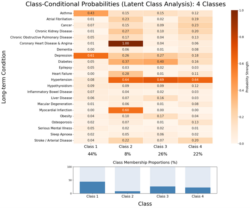
Figure 2. Heatmap defining the 4 disease clusters. Probabilities shown are conditional class probabilities: the probability that a patient assigned to that specific class will have a particular condition. Class 1 = Asthma & Depression, class 2 = Myocardial Infarction & Severe Heart Disease, class 3 = Cardio-metabolic & Obesity, class 4 = Hypertension/Milder Disease.
Differences were seen in terms of multimorbidity burden and demographic trends. For example, the average age of those in Class 1 was significantly lower than those in Classes 2 and 4. In terms of MSK conditions, a higher proportion was observed in Class 3 than in other classes. Patients in Class 2 experienced greater numbers of long-term conditions than in other classes, and higher proportions of inflammatory MSK conditions as opposed to non-inflammatory conditions. These findings suggest that a large proportion of the MLTC population is made up of those with Asthma and/or Depression, and additionally, MSK patients. Those with Cardio-metabolic Disease and Obesity were more likely to also have an MSK condition, and those with Myocardial Infarction & Severe Heart Disease were more likely to have greater multimorbidity, as were MSK patients.
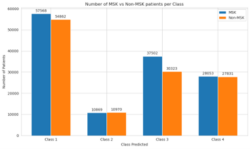
Figure 3. Grouped bar chart showing numbers of patients in each latent class, by MSK status
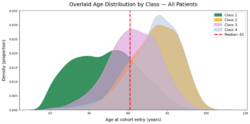
Figure 4. Smoothed kernel density estimate plots depicting age distributions by latent class (Fig 4) and further by MSK status (Fig 5)
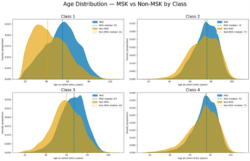
Figure 5. Smoothed kernel density estimate plots depicting age distributions by latent class (Fig 4) and further by MSK status (Fig 5)
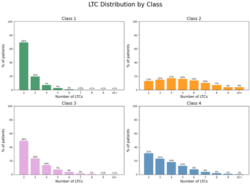
Figure 6. Long-Term Condition count distributions per class
Healthcare Utilisation
The following initial key healthcare utilisation metrics were observed following preliminary analysis.
- 1 in 5 health service contacts were unplanned
- The classes with the highest unplanned care rates were:
Class 2 (Severe MI/heart disease): 32% unplanned
Class 4 (Hypertension/milder disease): 28% unplanned
- The most used service type was scheduled GP visits (making up 58% of all care contacts), followed by planned outpatient care (19%) and unplanned inpatient stays (14%). The least used was out-of-hours contacts (<1%).
- MSK patients experienced higher overall healthcare use than non-MSK patients, mostly arising from planned care
- Despite making up 51.9% of the cohort, MSK patients accounted for 61.5% of all planned healthcare use, accounting for as high as 64.2% of acute planned attendances.
- For MSK patients, Classes 2 and 4 showed the highest rates of both planned and unplanned care, with the main drivers in higher rates of unplanned care being unplanned acute inpatient stays, 999 calls, and unplanned acute attendances. Amongst MSK patients, those in Class 2 experienced nearly 4 times the rate of unplanned care when compared to Class 1.

Figure 7. Mean total per-patient healthcare usage, separated by planned (solid bars) and unplanned (hatched bars) care, stratified by MSK status and displayed for each comorbidity group. Mean usage figures represent the maximum follow-up period of 3 years and 9 months.
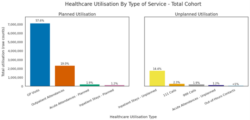
Figure 8. Total healthcare utilisation across the cohort showing proportion of usage by type of service, separated into planned and unplanned services. Total healthcare utilisation represents all utilisation over the total (maximum) follow-up period of 3 years and 9 months.
Challenges and Limitations
Certain limitations exist in the methods. Latent Class Analysis assumes associations between observed diseases are explained by the latent class; however, this may not hold true in reality. Causal inference was not used; therefore, although we have evaluated associations between disease clusters, MSK patients, and healthcare utilisation, we cannot make any conclusions about causality. Time limitations were experienced: extensions of this work could focus on stratified analysis using wider factors.
Value of The Results
A comprehensive clinical codelist for identifying and characterising MSK patients was created, with potential for re-use. This led us to more accurately identify musculoskeletal patients in Leeds within the Leeds Data Model, yielding almost double the number identified using the original definition. A similar approach could also be adopted for other conditions. This work also emphasises the benefit of the Latent Class Analysis approach for disease clustering, and revealed four major groups of commonly co-occurring conditions for MLTC patients in Leeds.
This project provides insight into the complex interplay between MLTC and MSK, which is often overlooked, displaying how multimorbidity clusters can vary according to MSK status. This highlights the success of using linked electronic health record data – in particular, the Leeds Data Model – to be able to map healthcare utilisation across a range of different points of access and combine metrics to holistically measure healthcare utilisation.
Preliminary health usage analyses were conducted. These offer an insight into where care is being accessed, and by whom. Findings highlighted an increase in planned health service use for MSK patients, when compared with non-MSK patients. MSK patients with Myocardial Infarction & Severe Heart Disease experienced the highest rates of both planned unplanned care, suggesting that both multimorbidity type and MSK status play a combined role in health service utilisation.
These insights could be valuable for health service planning, given the identification of distinct multimorbidity groups which highlight clinically meaningful heterogeneity among patients with MSK conditions. Exploring further patterns based on co-occurring conditions may help identify subgroups with distinct healthcare needs and utilisation profiles, which could in turn help inform targeted care planning.
Recommendations for Future Work
This study is just one facet of a wider effort to characterise healthcare utilisation in musculoskeletal patients with multimorbidity. Here, we have contributed towards answering the ‘who’ and ‘how’ questions: who is accessing health services more frequently, and how are they interacting with the health system?
Next steps should seek to address the ‘why’, ‘when’, and ‘where’ questions; for example, why do these groups experience differences in their health service use? At what point(s) in time does demand increase? And where are the opportunities for earlier intervention and de-duplication of care?
In this vein, future work might explore the key drivers and barriers behind these healthcare utilisation patterns, using, for example, trajectory mapping for examining changes over time, or causal inference for understanding the underlying factors shaping these patterns. Later stages would involve intervention design to streamline health service delivery, ultimately providing patients with more efficient and effective care.
This project emphasises the importance of including musculoskeletal patients at the forefront of multimorbidity research and health service planning.
“It is so great to see this work develop - gaining a greater understanding of how we can more accurately identify individuals with Musculoskeletal Disorders and how we can apply novel solutions to group people by common patterns of multiple long-term conditions.
It's also brilliant to see use of the Leeds Data Model to carry out these analyses and to demonstrate how a comprehensive linked data model can support this work.
Looking ahead, I am excited to see the final analyses to model simple patterns of service utilisation across and within these groups.”
Richard Irvine, Chief Data Officer, NHS West Yorkshire ICB
Key Actions
- Curated a comprehensive ICD-10 musculoskeletal disorder codelist
- Successfully identified musculoskeletal patients across Leeds using primary and secondary care data
- Constructed key multimorbidity subgroups defining chronic illness patients across Leeds: Asthma & Depression, Myocardial Infarction & Severe Heart Disease, Cardio-metabolic & Obesity, and Hypertension & Milder Disease
- Compared healthcare utilisation across musculoskeletal and multimorbidity subgroups
- Demonstrated the potential of the Leeds Data Model and linked electronic health data to gain valuable research insights
Key Findings
- MSK patients make up a majority of MLTC patients, with the highest proportion seen in the Cardio-metabolic & Obesity group
- Over two-thirds of musculoskeletal patients in Leeds were identified as having MLTC
- Preliminary work not accounting for other patient characteristics indicated that one-fifth of all delivered care across MLTC patients in Leeds was unplanned care and MSK patients experienced higher rates of planned care
- MLTC patients with Myocardial Infarction & Severe Heart Disease and Hypertension & Milder Disease, who were, on average, older, experienced higher rates of unplanned care
Key Implications
- Health services in Leeds could be shaped to accommodate specific musculoskeletal and multimorbidity patients’ needs
- Further work should seek to model healthcare utilisation taking into account a number of patient demographic characteristics – and to identify when and where interventions can be implemented to deliver high quality, patient-focused, and cost-optimised care
Project Team
- Emma Briggs, Data Scientist, Leeds Institute for Data Analytics, University of Leeds
- Dr Sarah Kingsbury, Associate Professor and Musculoskeletal Strategic Lead, Leeds Institute of Rheumatic and Musculoskeletal Medicine (LIRMM), University of Leeds
- Dr Marlous Hall, Associate Professor of Epidemiology, Leeds Institute of Cardiovascular and Metabolic Medicine (LICAMM) and Leeds Institute for Data Analytics (LIDA), University of Leeds
- Professor Philip Conaghan, Professor of Musculoskeletal Medicine, LIRMM, University of Leeds, Honorary Consultant Rheumatologist for LTHT & Director of the NIHR Leeds Biomedical Research Centre
- Richard Irvine, Chief Data Officer, Leeds City Council/ NHS West Yorkshire ICB
Funder
This work was funded by the National Institute for Health and Care Research (NIHR) through the Leeds Biomedical Research Centre (NIHR203331). The views expressed are those of the authors and not necessarily those of the NHS, the NIHR or the Department of Health and Social Care.
This work has been facilitated by the Leeds Institute for Data Analytics (LIDA) Data Scientist Development Programme, which employs early-career data scientists to deliver real-world data-driven impact in the interests of the public good.
References
- ArthritisUK 2025. The State of Musculoskeletal Health 2025: Arthritis and other musculoskeletal conditions in numbers [Online]. London, UK.
- Barnett, K., Mercer, S.W., Norbury, M., Watt, G., Wyke, S. and Guthrie, B. 2012. Epidemiology of multimorbidity and implications for health care, research, and medical education: a cross-sectional study. The Lancet. 380(9836), pp.37–43.
- Cassell, A., Edwards, D., Harshfield, A., Rhodes, K., Brimicombe, J., Payne, R. and Griffin, S. 2018. The epidemiology of multimorbidity in primary care: a retrospective cohort study. British Journal of General Practice. 68(669), pp.e245–e251.
- Evans, D.W., Rushton, A., Middlebrook, N., Bishop, J., Barbero, M., Patel, J. and Falla, D. 2022. Estimating Risk of Chronic Pain and Disability Following Musculoskeletal Trauma in the United Kingdom. JAMA Network Open. 5(8), p.e2228870.
- GOV UK 2018. Data Protection Act [Online]. London, UK: The Stationery Office.
- GOV UK 2022. Musculoskeletal health: applying All Our Health.
- GOV UK 2021. UK General Data Protection Regulation (GDPR) [Online]. The Stationery Office.
- Health Innovation Leeds 2025. Revolutionary research collaboration in Leeds redesigns healthcare for people with multiple long-term conditions.
- Health innovation Leeds and Leeds City Council n.d. Leeds Office for Data Analytics.
- Information Commissioner’s Office (ICO) n.d. Data protection principles - guidance and resources.
- Ingram, M. and Symmons, D.P.M. 2018. The burden of musculoskeletal conditions. Medicine. 46(3), pp.152–155.
- Leeds Health and Care Partnership 2026. Healthy Leeds Plan. Section 4: Population Health Infrastructure. The Leeds Data Model.
- NHS n.d. Best Practice Solutions: Musculoskeletal Health.
- NICE 2016. NICE Guideline NG56. Multimorbidity: clinical assessment and management.
- NIHR 2024. NIHR Strategic Framework for Multiple Long-Term Conditions [Online]. UK: National Institute for Health Research.
- Office for National Statistics (ONS) 2016. Disclosure Control: Health Statistics.
- Office for National Statistics (ONS) 2006. Review of the Dissemination of Health Statistics: Confidentiality Guidance [Online]. Crown copyright.
- Skou, S.T., Mair, F.S., Fortin, M., Guthrie, B., Nunes, B.P., Miranda, J.J., Boyd, C.M., Pati, S., Mtenga, S. and Smith, S.M. 2022. Multimorbidity. Nature Reviews Disease Primers. 8(1), p.48.
- Willadsen, T.G., Bebe, A., Køster-Rasmussen, R., Jarbøl, D.E., Guassora, A.D., Waldorff, F.B., Reventlow, S. and Olivarius, N.D.F. 2016. The role of diseases, risk factors and symptoms in the definition of multimorbidity – a systematic review. Scandinavian Journal of Primary Health Care. 34(2), pp.112–121.