
Data Scientist Development Programme (DSDP)
Building a Diverse and Future-Ready Data Workforce
The LIDA Data Scientist Development Programme (DSDP) is an award-winning data science employability programme that provides on-the-job training and experience working on real-world data projects for graduates and career changers seeking careers in data science. It does this while delivering real-world data insights for private, public and third sector partners, addressing their most pressing business challenges and questions.
The DSDP is fulfilling Global Sustainable Development Goals by supporting building innovation capacity and better data-driven decision making; ensuring equity and inclusion in its practices; unites academic, government and industry to deliver impact; and focuses on local insights for global goals .
Bridging the UK’s Data Skills Gap

The UK’s data workforce faces both major opportunities and persistent challenges. Each year, an estimated 178,000 data roles are advertised, with only ~10,000 UK graduates to fill them. Demand for data talent is soaring across sectors, driven by AI adoption, digital transformation of the public sector and services, and a shift toward skills-based hiring.
However, pay gaps, traditionally weak career pathways, outpaced training, poor data infrastructure, and regional inequalities all hinder data workforce resilience and retention. Together, these trends underline the importance of programmes like the DSDP – initiatives that combine comprehensive training practices, real-world experience in areas impacting the public good, and structured mentorship for industry-preparedness to help strengthen the UK’s data capability.
In 2024–25, eight full-time data scientists joined the programme as a result of recruitment practices that continue to recognise, challenge and bridge the STEM skills gap through diversifying the early-career data scientist talent pipeline.

Following earlier successful positive-action initiatives for candidates from Global Majority backgrounds, a third of this year’s recruits identified as coming from low socio-economic backgrounds, in direct fulfilment of recommendations made in advice to Government by POST.
Now celebrating its tenth anniversary, the programme’s purpose remains clear: to develop the next generation of data scientists who can navigate the fast-changing landscape of artificial intelligence (AI), data governance, and digital transformation, while applying data analytics with data storytelling for better understanding across society, business, and government.
View 2024-25 Projects
Partnerships
The 2024–25 cohort worked with a broad range of partners from across academia, government, and industry, ensuring that the data scientists’ skills were applied to issues with direct public benefit. Nine pathways to policy impact were identified across this year’s projects, and one of this year’s data scientists has gone on to work for a DSDP industry partner.
Within the University of Leeds, and in support of LIDA’s policy of engaging a breadth of academic collaborators, the DSDP collaborated with the Consumer Data Research Centre, the Vulnerability and Policing Futures Research Centre, and the MRC TARGET partnership, as well as nine schools across the University and seven international university partners.
Externally, the programme partnered with organisations including 4-Xtra, Ocado, Mastercard, NIHR, Geolytix, Leeds City Council, Connected Bradford, the Bradford Institute for Health Research, Bradford Teaching Hospitals NHS Trust, Bradford Metropolitan District Council, Bradford Children’s Trust, the NHS West Yorkshire Integrated Care Board, the British Geological Survey, and Geosolutions Leeds.
These collaborations demonstrate the programme’s commitment to interdisciplinarity (LIDA R&I Strategy objective 1 and 2) and to building bridges between data science research and real-world practice, both in government and for business.
April 2025 saw the DSDP take part in the launch event of the collaborative partnership between the DSDP and HDR UK’s Black Internship Programme, supported by the Leeds Chapter of the Black Young Professionals Network, aimed at growing diverse pipelines into the data workforce and increasing the accessibility of DSDP recruitment.


Links to Global Sustainable Development Goals
The 2024–25 cohort delivered 16 proof-of-concept projects addressing real-world issues aligned with the UN Sustainable Development Goals (SDGs) and LIDA E&T and R&I strategy objectives 1 and 3. These included studies on:
Economic resilience
Understanding how communities recover from financial shocks (SDG 8, SDG 10).
Patient safety and health equity
Precision medicine
Policy modelling
Sustainable transport
Mapping e-cargo bike use to inform urban decarbonisation (SDG 7, SDG 11, SDG 13).
Crime & safety data
creating standard indicators for community safety (SDG 11, SDG 16).
Education & youth outcomes
Identifying early predictors of young people becoming NEET (Not in Education, Employment or Training) (SDG 4, SDG 8, SDG 10).
Children in care
Understanding factors that lead to children entering the care system (SDG 1, SDG 3, SDG 10).
Finding healthy online
Exploring shifting consumers towards healthier eating habits (SDG 3, SDG 9, SDG 17).
Scalable visualization of synthetic data
Contributing to an AI-ready tech and research workforce (SDG 8, SDG 9, SDG 17).
Psychiatric hospital treatment and readmission
Understanding where targeted interventions can be made to prevent those with mental health conditions getting stuck in secondary care systems (SDG 3, SDG 10).
Predicting rock texture
In order to understand locations for aquifers, reservoirs and storage sites as we work towards decarbonisation (SDG 12, SDG 13)
The DSDP is strengthening evidence-based policymaking, improving inclusion, and localising sustainability challenges. Across all 16 projects, a few consistent policy insights emerged:
- Better data linkage across health, education, and social systems unlocks insights not visible from single datasets.
- Equity matters: policies must consider geographic and socio-economic inequalities to avoid deepening divides.
- Early intervention pays off: addressing risks in childhood and early-years education has long-term social and economic benefits.
- Local focus: analysing data at neighbourhood level helps target resources more effectively.
- Interdisciplinary collaboration: combining methods from health, environment, and social sciences produces richer, more realistic findings.
- Accessible tools: dashboards and visualisations make research usable for policymakers and the public alike.
Overall Message for Policymakers
The shared lesson is that integrated, data-driven, and locally granular analysis enables smarter, fairer, and more anticipatory policy decisions — moving from reactive responses to proactive, evidence-led policymaking.
Achievements and Impact
In 2024–25, the DSDP delivered impact in line with LIDA Strategy R&I objective 3 across three main dimensions: skills development, research outputs, and societal benefit.
Technical and Research Outputs
The programme produced an impressive range of tangible data outputs, including:
- 25 new data outputs, including 11 datasets, 4 dashboards, 1 database, 2 web applications, 4 models, and 3 visualisations.
- 17 case studies, 7 conference papers, 8 academic papers-in-planning, and 7 public engagement events.
- Topical blogs:
- 5 projects currently seeking follow-on funding to scale their work.
For example, the Ocado eye-tracking project created an interactive dashboard to explore customer behaviour and inform approaches to healthy product messaging. Many other projects developed open-source tools and visualisation platforms to help partners explore findings and test scenarios for policy and strategy.
Recognition and Awards
Five DSDP participants won the LIDA-ITS Network Visualisation Hackathon in October 2024, showcasing the cohort’s critical thinking, teamwork and technical excellence.
Mentoring and Retention

The programme’s enhanced mentoring scheme has been a major success with ~190 mentoring hours devoted to the Programme 2024-25. The growing mentoring team supported data scientists in areas such as public speaking, leadership, and career development. One participant described it as “a safe, supportive space where I gained the confidence and tools to exceed my goals.”
This renewed focus on employability and development, together with targeted career support, contributed to a drop in DSDP early-leaver rates from 36% last year to just 16% in 2024–25. The mentoring model is now also being used as a blueprint for the MRC PROMOTE initiative, which will support mid-career health data scientists through mentoring.
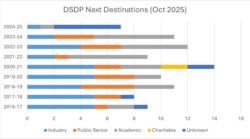
Where are they now? A look at 10 years of LIDA Data Scientist next destinations
Some industry next destinations include: Paiqo, Morrisons, Geolytix, Asda, Accenture and three organisations founded by former LIDA data scientists. Public Sector next destinations include: ONS, DWP, local government, Active Travel England and NHS. The greatest academic next destination remains the University of Leeds, indicating the strength of academic relationships forged through the DSDP and Leeds’s competence in talent retention.
In 2024–25, the DSDP strengthened its position as a national leader in data skills development. It also continues to equip early-career data scientists with the expertise, confidence, and collaborative mindset needed to thrive in a rapidly evolving data economy.
By combining technical and interpersonal excellence, inclusive recruitment, and real-world impact, the DSDP is not only helping to close the UK’s data skills gap – it is also shaping a future in which data science serves society, supports fairness, and drives sustainable change.
Find out more about the DSDP Return to the Annual Showcase 2025